
How to Create a History Timeline
History assignments love timelines. Ancient Rome. World War II. The Industrial Revolution. Your teacher wants dates, events, and something that looks like you cared.
The awkward part: history doesn't always give you neat dates.
Decide your scope first
Before choosing events, decide what story you're telling:
- One person's life — birth, education, achievements, death
- A war — causes, key battles, end
- An empire — rise, peak, decline
- An era — major shifts across decades or centuries
Your scope controls how many events you need. A poster on Ancient Rome might use 6–8 events across 1,000 years. A World War II timeline might use 12–15 across six years.
Pick events that tell a story
Choose turning points, not trivia.
Roman Empire example (fictional school set):
| Date | Event |
|---|---|
| 753 BCE | Legendary founding of Rome |
| 509 BCE | Roman Republic established |
| 27 BCE | Augustus becomes first emperor |
| 117 CE | Empire reaches greatest extent |
| 476 CE | Fall of the Western Roman Empire |
Five events. A thousand years. Readable.
Handling tricky dates
BCE and CE
Enter BCE dates as 500 BCE or 44 BCE. They sort before CE dates.
Approximate dates
Use c. 1200 BCE or circa 1450 when historians aren't precise.
Date ranges
Wars and eras often span years: 1914 - 1918, 1861 - 1865.
Named periods without exact dates
Some periods don't have clean years: Stone Age, Victorian Era, The Enlightenment.
In Simple Timeline Maker, you can use these as date labels. They appear on the timeline as readable text. They won't sort precisely alongside exact dates — that's fine for mixed posters where the label matters more than millimetre-perfect spacing.
For a timeline that's mostly period labels, consider grouping by era in your write-up rather than forcing strict chronology everywhere.
What it looks like
Here's the Roman Empire example in the Historical style:
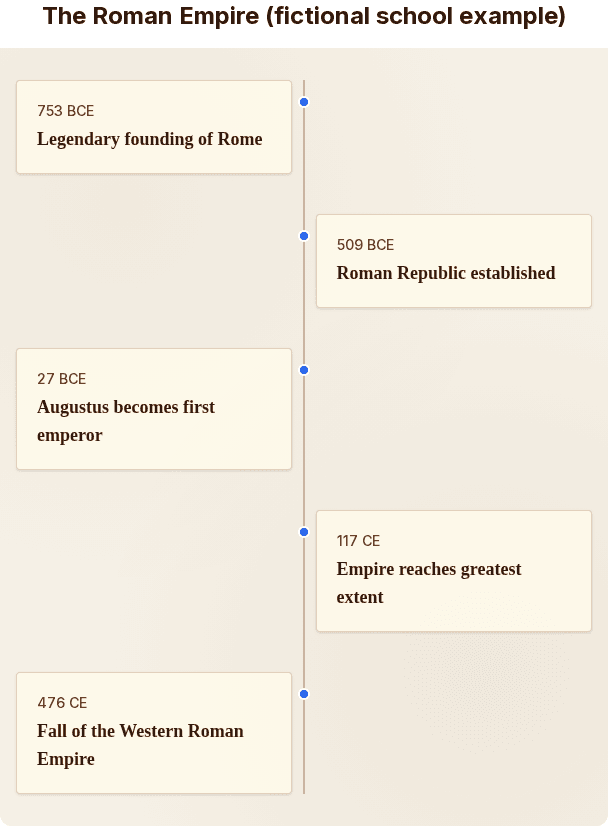
Historical suits history posters. Classic works for formal essays. Clean if your teacher prefers minimal design.
You can switch styles without retyping events.
Writing descriptions
One sentence per event is enough.
Good: "Augustus ended decades of civil war and established the Pax Romana."
Too much: Three paragraphs on the Second Triumvirate that nobody will read on a poster.
Save depth for your essay. The timeline is the map, not the book.
Paper or digital?
For a physical classroom poster, drawing by hand is often what the assignment asks for.
For a slide presentation or printed handout, export a PNG from Simple Timeline Maker — one preview page at a time on the free tier. Premium (£12.99 once) adds a single slide-ready PNG, PDF, or PowerPoint file when your timeline spans multiple pages.
Both start with the same event list.
Checklist
- Events in chronological order (BCE before CE)
- Short, readable titles
- Spelling correct on names and places
- Not too many events — white space helps
- Visual style matches the subject (Historical for ancient history, etc.)
Related guides
Create your history timeline — choose Historical style, enter your dates, export when ready. See Pricing if you need one combined file for a long timeline.